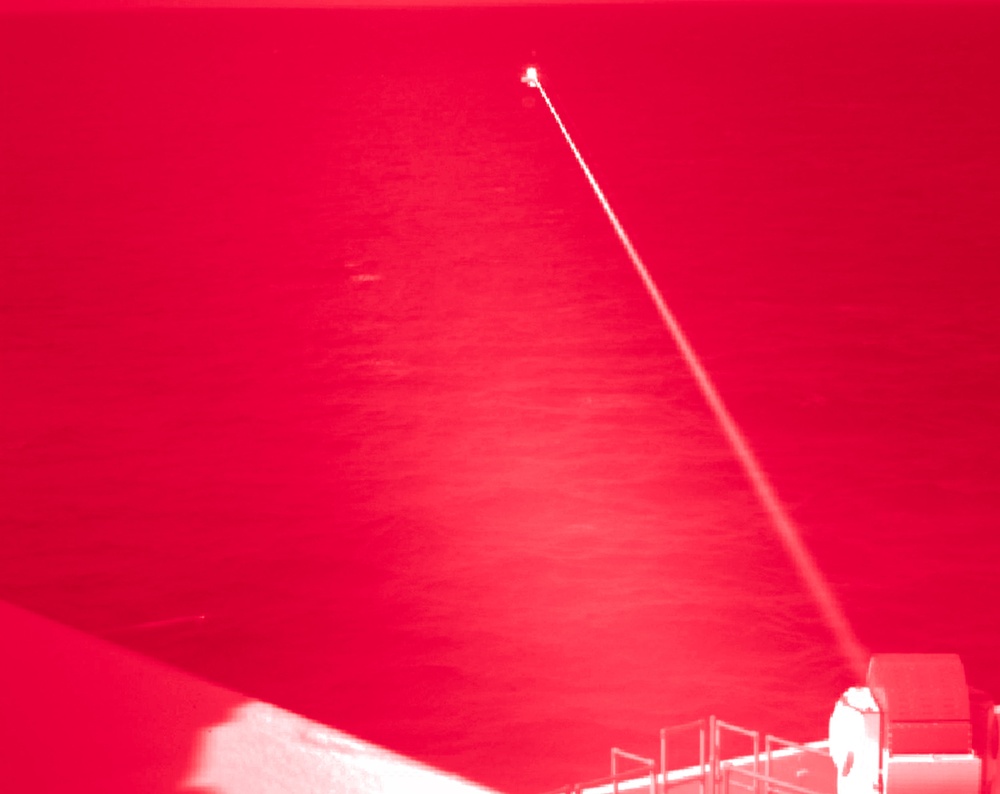
GULF OF ADEN (Dec. 14, 2021) — Amphibious transport dock ship USS Portland (LPD 27) conducts a high-energy laser weapon system demonstration on a static surface training target, Dec. 14, while sailing in the Gulf of Aden. (U.S. Navy photo illustration by Mass Communication Specialist 2nd Class Devin Kates)
For decades, ship self-defense has followed a familiar logic: detect the threat, assign a weapon, and engage in range-based layers—missiles out far, guns in close—guided by doctrine and refined by experience. Directed energy changes that playbook.
High-energy lasers and high-power microwave systems don’t just add another “shooter” to the checklist. They introduce new dependencies—atmosphere, dwell time, power and cooling limits, and deconfliction constraints—that turn “what do we shoot?” into a harder question: what can we sustain right now, and for how long?
In the Winter 2025 issue of the Naval Engineers Journal, a technical paper from the Naval Postgraduate School (NPS) digs into that emerging decision problem: how future combat systems should coordinate kinetic weapons with directed-energy effects across fast-moving maritime threat scenarios.
The paper frames the challenge in a way that will feel familiar to anyone who has lived inside a combat system: more sensors, more effectors, more “options”… and a rapidly expanding decision space. Directed energy can enable hard kills, soft kills, sensing, dazzling, and microwave disruption—but those effects behave differently than missiles and guns, and they come with different constraints.
Here’s the shift the authors want readers to internalize: layered defense with kinetic systems is largely range-driven. With directed energy, engagements become time-driven.
- Dwell time becomes a planning variable. Lasers often need sustained time on target to achieve an effect.
- The environment becomes a limiter. Atmospheric conditions can reduce power delivered on target and change outcomes.
- Ship resources become tactical constraints. Power generation, cooling capacity, and duty cycles affect how often you can fire.
- Deconfliction becomes more complex. Coordinating beams, fires, and friendly assets introduces new timing and safety constraints.
Put differently: the “best” engagement plan may change minute to minute—even against the same threat type—based on weather, geometry, system state, and how hard you’ve already been working your power and thermal margins.
To explore this, the NPS research program uses multiple analytical lenses—each aimed at understanding a different slice of the problem:
- Systems analysis using modeling and simulation to compare weapon/threat matchups and operational constraints
- Kill chain functional analysis to expose the extra decision steps lasers demand (especially around assessment and re-engagement)
- Solution analysis to test concepts like new engagement doctrines and automated decision aids
One of the most interesting implications is where this leads the combat system: once ships field both kinetic and non-kinetic options, automation becomes hard to avoid. The system will need decision logic that can rapidly evaluate context, recommend coordinated strategies, and support re-engagement decisions with credible battle-damage assessment—without overwhelming watch teams with variables.
The full paper goes deeper into the frameworks and methods the NPS team is using (including modeling approaches, kill-chain constructs, and where machine learning can realistically help). If you want the technical detail behind how this decision space is being mapped—and what that means for future combat system design—access the Winter 2025 NEJ issue here:
Read the Winter 2025 NEJ issue / get access to the paper
ASNE members receive NEJ access as a core benefit. If you’re working ship defense, combat systems integration, autonomy, power/cooling, or next-gen survivability, this is the kind of analysis NEJ exists to publish.